بِسْمِ اللَّهِ الرَّحْمَٰنِ الرَّحِيمِ
Assalaamu Alaikum wa Rahmatullahi wa Barakaatuh
Jumadath-Thani 18, 1448 AH / Saturday, November 28, 2026
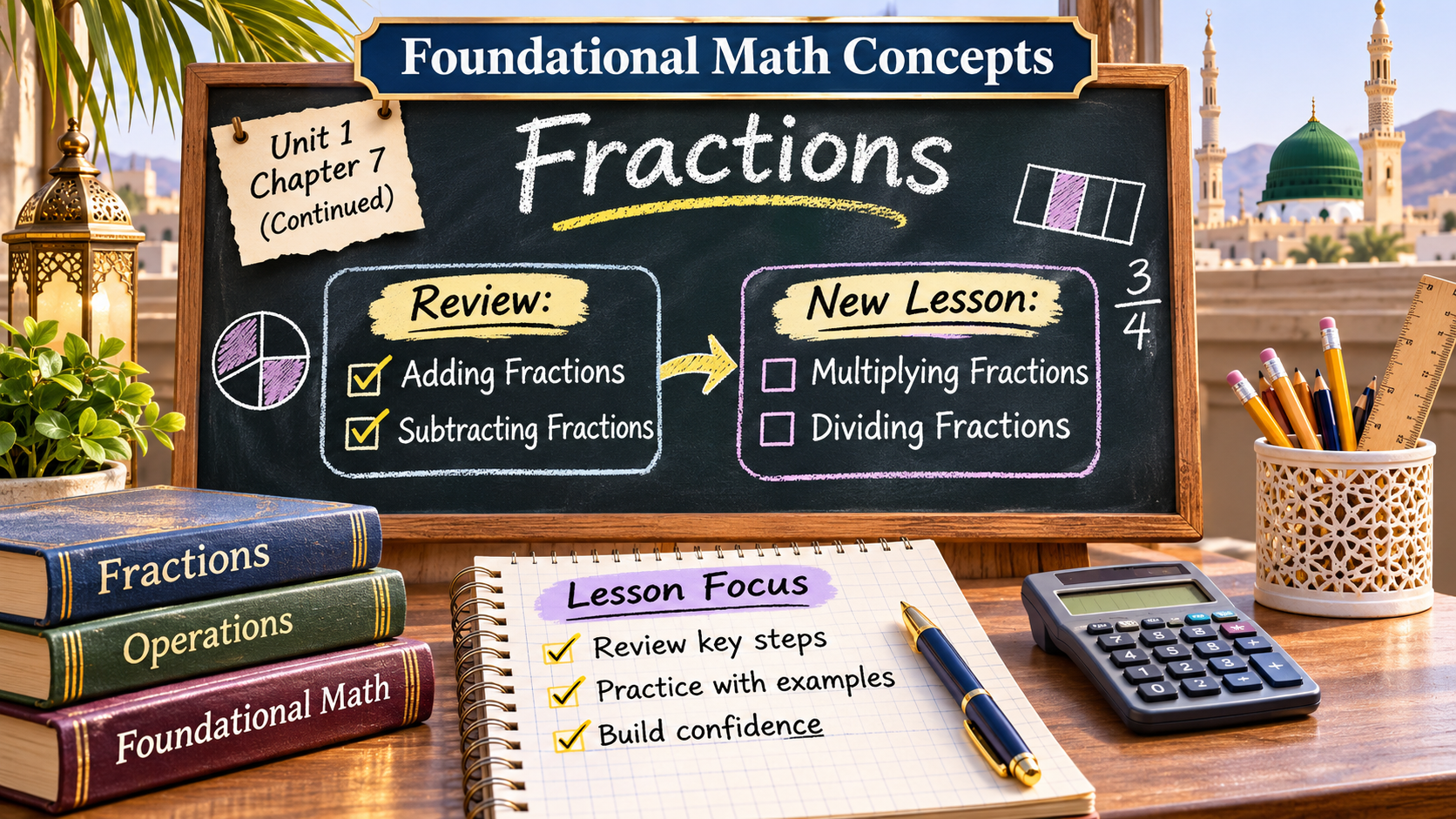
Alhamdulillah, welcome to Foundational Math Concepts! This week we review adding and subtracting fractions, then begin multiplying and dividing fractions. Our aim is steady progress through understanding, written steps, and practice.
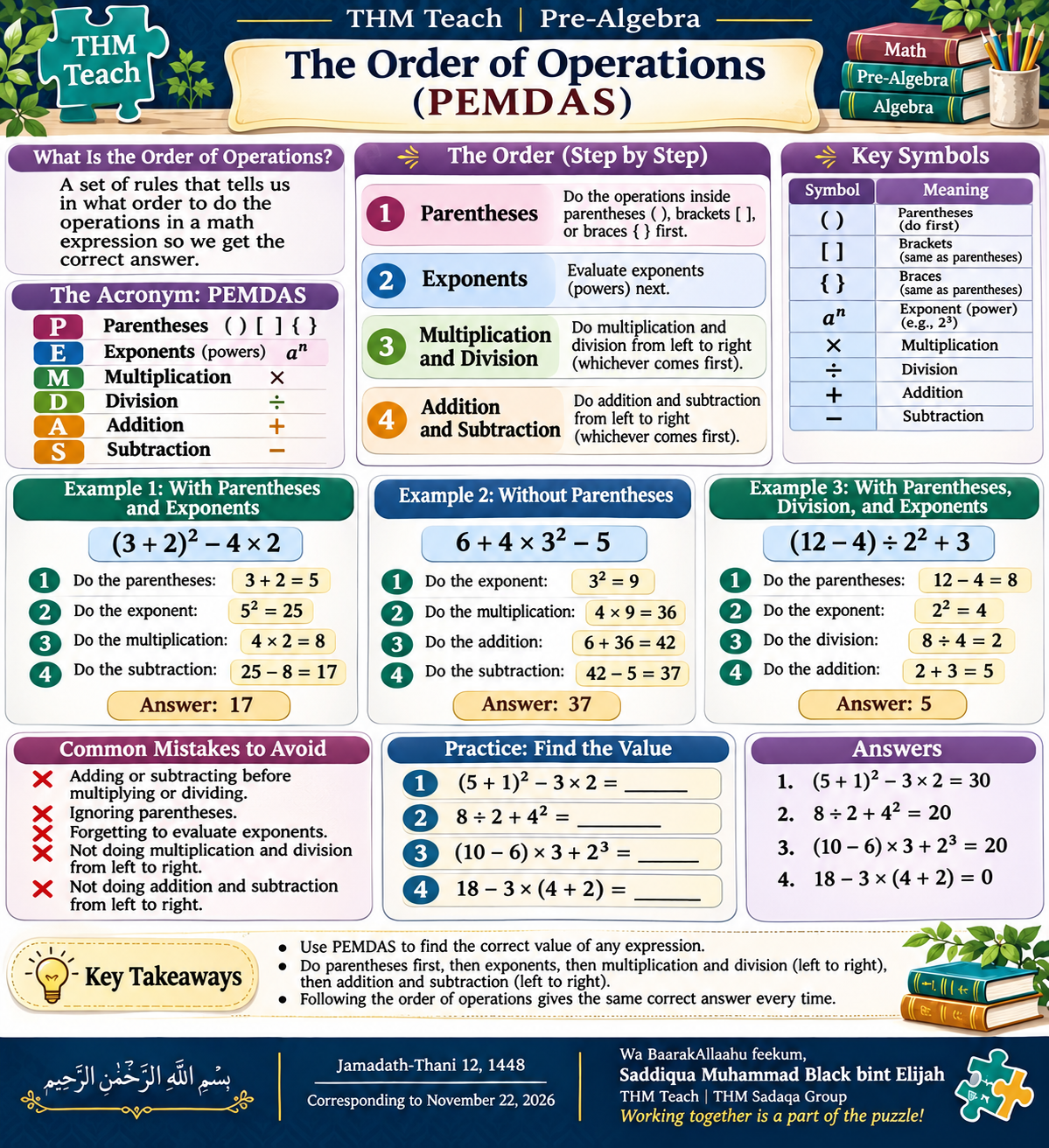
Review our earlier lesson: Introduction to Fractions — Multiweek Learning Guide.
Part 1 — Review: Adding and Subtracting Fractions
Identify the numerator (top number) and denominator (bottom number). Recall proper fractions, improper fractions, and mixed numbers.
Like denominators: Add or subtract the numerators; keep the denominator. Example: 2/7 + 3/7 = 5/7.
Unlike denominators: First find a common denominator, using the least common multiple (LCM) when helpful. Example: 1/2 + 1/4 = 2/4 + 1/4 = 3/4.
Simplify a final fraction when possible by dividing its numerator and denominator by their greatest common factor (GCF).
Part 2 — New Lesson: Multiplying Fractions
Unlike addition and subtraction, multiplying fractions does not require common denominators.
- Multiply the numerators.
- Multiply the denominators.
- Simplify the product if needed.
Example: (2/3) × (3/5) = 6/15 = 2/5.
Cross-reducing (canceling)
Before multiplying, we can divide a numerator and a denominator by a common factor. Our textbook example is (6/12) × (8/24). Cross-reduce 6 and 12 by 6, and 8 and 24 by 8, giving (1/2) × (1/3) = 1/6. Canceling is optional, but often makes the multiplication easier.
Part 3 — New Lesson: Dividing Fractions
To divide by a nonzero fraction, multiply by its reciprocal. The reciprocal of 4/5 is 5/4.
- KEEP the first fraction.
- CHANGE division to multiplication.
- FLIP the second fraction (take its reciprocal).
- Multiply and simplify.
Example: (2/3) ÷ (4/5) = (2/3) × (5/4) = 10/12 = 5/6.
Lesson Objectives
- Review addition and subtraction with like and unlike denominators.
- Identify when common denominators are and are not needed.
- Multiply fractions, using cross-reducing when helpful.
- Find reciprocals and divide fractions.
- Show steps and explain mathematical reasoning.
Homework — Practice What You Learned
Student 5-digit identification number: __________
Directions: Solve each problem. Show your steps, simplify each answer, and label the operation. You may write answers on paper and send them through your class’s usual submission method.
A. Review — Addition and Subtraction
- 1/6 + 4/6 = ?
- 5/8 − 2/8 = ?
- 1/3 + 1/6 = ?
- 3/4 − 1/8 = ?
B. Multiply Fractions
- 2/3 × 1/4 = ?
- 3/5 × 2/9 = ?
- 4/7 × 7/8 = ?
- 6/12 × 8/24 = ? (Try cross-reducing.)
C. Divide Fractions
- 1/2 ÷ 1/4 = ?
- 3/5 ÷ 2/3 = ?
- 4/7 ÷ 2/7 = ?
- 5/6 ÷ 5/12 = ?
D. Word Problem and Reflection
13. A recipe uses 3/4 cup of flour for one batch. How much flour is needed for 2/3 of a batch? Show your multiplication and simplify.
14. Explain in your own words why addition of fractions may require a common denominator while multiplication does not.
15. What is the reciprocal of 7/9? Explain how you know.
Parents and learners: You are welcome to ask for additional step-by-step practice and explanations. Use the posted lesson as your main guide, and bring questions to class.
May Allah grant us beneficial knowledge, understanding, patience, and success in our studies. Allahumma aameen.
THM Teach — Free Foundational Math Concepts Coursework
Saddiqua Muhammad Black bint Elijah
Compiled/edited by UmmuChat. Newly developed practice questions are for learning and review.