
Exploring the Microscopic World: Honey Bee Leg and Wing
Introduction to Scientific Exploration:
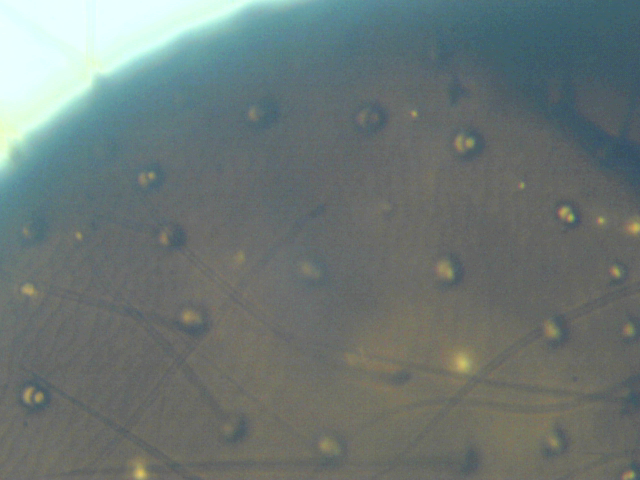
In today’s lesson, students had the exciting opportunity to explore the world of the honey bee through a microscope. This hands-on activity allowed us to observe the intricate details of a honey bee’s leg and wing, helping us understand the structure and function of this essential insect in nature. Using the AmScope Microscope, we gained a close-up view of these small but powerful parts of the honey bee, giving us insight into their role in pollination and daily life.
Understanding the Microscope:

A microscope is an essential tool in scientific studies that allows us to observe objects too small to be seen with the naked eye. By using lenses to magnify these tiny details, we can study the intricate structure of cells, tissues, and microorganisms. The AmScope Microscope, used in our class, provides high levels of magnification and clear resolution, making it ideal for studying biological specimens like the honey bee’s leg and wing.
Slides Used for Microscopy:
Microscope slides are thin pieces of glass where small objects or samples are placed for examination. In this experiment, we used prepared slides showing the leg and wing of a honey bee. These slides are placed on the microscope stage and illuminated from below, making the tiny features visible when magnified.
The Honey Bee’s Anatomy:
Honey bees are known for their critical role in pollination, making them vital to our ecosystem. Here’s a brief look at the two parts we examined:
- The Honey Bee’s Leg: The honey bee’s legs are multi-functional and uniquely adapted to their role in gathering pollen. Their legs have specialized structures like the pollen basket (also called the corbicula) on the hind legs, which allows them to collect and transport pollen back to the hive. The detailed examination through the microscope revealed the bristles and joints that help in this process.
- The Honey Bee’s Wing: The honey bee’s wings are made of a thin, transparent membrane supported by veins. They are powerful and allow the bee to fly at high speeds. Our microscopic observation showcased the delicate network of veins that provide both strength and flexibility to the wings, essential for their flight and maneuverability.
Why Study Honey Bees?
Studying honey bees and their anatomy helps us appreciate their crucial role in the environment. Understanding their physical structure provides insights into how they perform their vital tasks of pollination and food production for their colonies.
Conclusion:
This lab activity has deepened our understanding of how honey bees operate in the natural world, and how tools like microscopes can open up a new perspective on small creatures. By studying their legs and wings under the microscope, we can better appreciate their efficiency and importance in sustaining the environment.
Science Lab SL01.0: Homework Assignment – Further Exploration of the Honey Bee
Research Task:
- Research the Honey Bee’s Role in the Ecosystem:
- Conduct research to explore the importance of honey bees in pollination and their impact on agriculture and food production.
- Write a brief summary (200–300 words) about how honey bees contribute to sustaining plant life and how their decline could affect the environment.
Activity:
- Create a Pollination Model:
- Using materials from home (such as paper, markers, or even small seeds), create a simple model or diagram that shows how honey bees carry out pollination. Label each part of the model to demonstrate the process.
- Take a photo of your completed model and bring it to our next class for a discussion on how the anatomy of the honey bee supports its role as a pollinator.
Submission Deadline: [Insert date]
Certainly! Here’s how we can connect the lesson to statements from the Noble Quran and Hadith regarding bees:
Science Lab SL01.0: Homework Assignment – Further Exploration of the Honey Bee
Connecting to the Noble Quran:
In this study of the honey bee, we are reminded of the magnificent creation of Allah subhanahu wa ta’ala. In the Noble Quran, Allah mentions the bee in Surah An-Nahl (16:68-69): Commentary #2
وَأَوْحَىٰ رَبُّكَ إِلَى ٱلنَّحْلِ أَنِ ٱتَّخِذِى مِنَ ٱلْجِبَالِ بُيُوتًا وَمِنَ ٱلشَّجَرِ وَمِمَّا يَعْرِشُونَ
ثُمَّ كُلِى مِن كُلِّ ٱلثَّمَرَٰتِ فَٱسْلُكِى سُبُلَ رَبِّكِ ذُلُلًا يَخْرُجُ مِنۢ بُطُونِهَا شَرَابٌ مُّخْتَلِفٌ أَلْوَٰنُهُۥ فِيهِ شِفَآءٌ لِّلنَّاسِ إِنَّ فِى ذَٰلِكَ لَءَايَةً لِّقَوْمٍ يَتَفَكَّرُونَ
“And your Lord inspired the bee, saying: ‘Take for yourself homes in the mountains, and in the trees and in what they build. Then eat from all the fruits and follow the ways of your Lord laid down for you.’ There emerges from their bellies a drink, varying in colors, in which there is healing for people. Indeed in that is a sign for people who give thought.”
This ayah (verse) beautifully illustrates the guidance Allah subhanahu wa ta’ala has given to the bee and the benefits that honey provides to mankind.
*read the commentary about the ayaat for additional understanding in shaa’Allaah
You must be logged in to post a comment.